
In the 1930s, Oklahomans were just trying to breathe. Dust storms blackened the noon sun, soil drifted against fence lines, and families pressed wet cloths over their mouths to make it through another day. The sky felt hostile, empty, merciless.
And yet, in those same years, that very sky was being claimed for the first time. Barely three decades had passed since the Wright brothers left the ground, and flight was still an infant’s daring crawl into a new frontier. Engines coughed awake on grass runways, propellers carved the morning air, and a handful of pioneers lifted off into the unknown.
Among them was Amelia Earhart — a woman who turned the same sky that smothered the Plains into a canvas of possibility.
Nearly ninety years after her disappearance, Earhart’s name is back in the news. President Trump has ordered the release of government records tied to her final flight, sparking fresh debate about what — if anything — might be revealed. Some historians doubt the files hold any new answers. Others wonder if even a single scrap could shift the mystery.
But maybe that’s the point.
AMELIA EARHART AT A GLANCE - 1897 – Born in Atchison, Kansas - 1932 – First woman to fly solo across the Atlantic - 1935 – First person to solo from Hawaii to California - 1937 – Departs on attempt to circumnavigate the globe - July 2, 1937 – Last radio contact near Howland Island; disappears - 2025 – President Trump orders release of government records tied to her disappearance
Amelia Earhart was never just about answers. She was about daring.
Amelia Mary Earhart was born in 1897 in Atchison, Kansas — just six years before the first powered flight. She grew up under skies that seemed endless, and when aviation was still in its infancy, she stepped into it as if it had been waiting for her.
In 1932, she became the first woman to fly solo across the Atlantic. In 1935, she became the first person — man or woman — to solo from Hawaii to California, a route that had already claimed lives. She co-founded the Ninety- Nines, the international organization of women pilots headquartered today in Oklahoma City.
Her Lockheed Electra 10E, the “Flying Laboratory” bankrolled by Purdue University, was built for a single audacious goal: to circle the globe at its widest point.
But her greatest leap may have been personal. In a letter to her future husband, publisher George Putnam, she confessed, “You must know again my reluctance to marry…” Her one condition was that marriage could never tether her to the ground. Aviation was her true love, everything else came second.
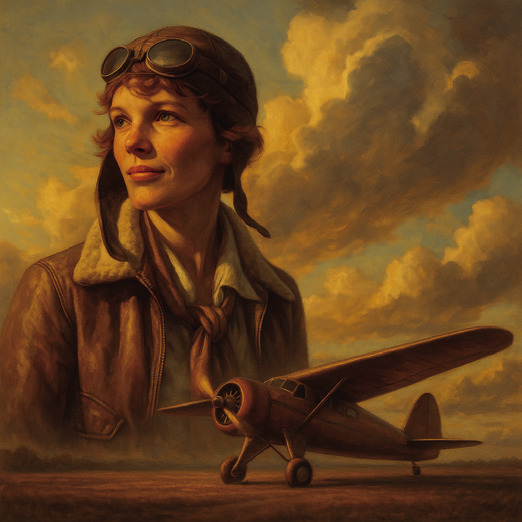
It’s easy to see only the romance: the leather jacket, the wind-tossed hair, the easy smile. But flight in the 1930s was no luxury. The air was loud and frigid. Engines failed. Radios sputtered. Weather forecasts were guesswork. Pilots navigated by stars, by gut, by sheer will.
Earhart lived that reality. In March 1937, on her first attempt at the world flight, her Electra ground-looped on a Hawaiian runway and skidded to a stop in a heap of bent metal. She walked away unhurt, rebuilt the plane, and tried again. Tough as boot leather, undeterred.
The 1930s offered a world full of firsts. You could still be the first to cross an ocean, the first to chart a route, the first to circle the globe. For ordinary people struggling through the Depression, every flight carried the thrill of a barrier being broken.
Today, our frontiers are harder to see. We look to space or the deep ocean and wonder what’s left to conquer. But in Earhart’s time, the Atlantic itself was as frightening as the stars are to us now. Imagine climbing into a twin-engine plane with engines that were as uncertain as the weather, where a missed oil change or loose bolt could decide your fate. Maintenance schedules were rough guesses, not science. Every gauge was manual, every adjustment made by hand, and navigation depended on the stars, the sun, and your own nerve.
There were no electronics. No autopilot. No radar sweep to warn of storms ahead. It was all dead reckoning, stick and rudder — pure fly-by-feel. And yet Earhart did it anyway, pointing her nose at horizons that most people never dreamed of touching.
On July 2, 1937, Earhart radioed the Coast Guard cutter Itasca near Howland Island. Static filled the air. “We are running north and south…” And then — silence. No wreckage. No trace. Just the Pacific, endless and unmoved.
The search has never stopped. Expeditions comb islands. Satellites scan the ocean floor. Hobbyists rebuild 1930s radios, trying to catch echoes. Presidents order files unsealed. And still, the mystery hangs in the air.
But do we even want it solved? Because maybe the romance is in the not-knowing. The unfinished story means we all get to finish it ourselves — imagining Earhart’s last moments as bravery or calm, tragedy or triumph. The absence of an ending keeps her alive, not buried in a file box.
So yes, Amelia Earhart is back in the headlines. But the truth is, she never really left. She is America’s unfinished sentence, suspended between courage and mystery. She reminds us of a time when flight was still a baby’s first steps, when danger was close, and when the sky was both hostile and full of promise.
And maybe that’s why we don’t need all the answers. Because as long as the sky is wide and the ending unwritten, Amelia Earhart’s story is still flying — in our history, in our imaginations, and in the dreams of anyone who ever dared to look up.