
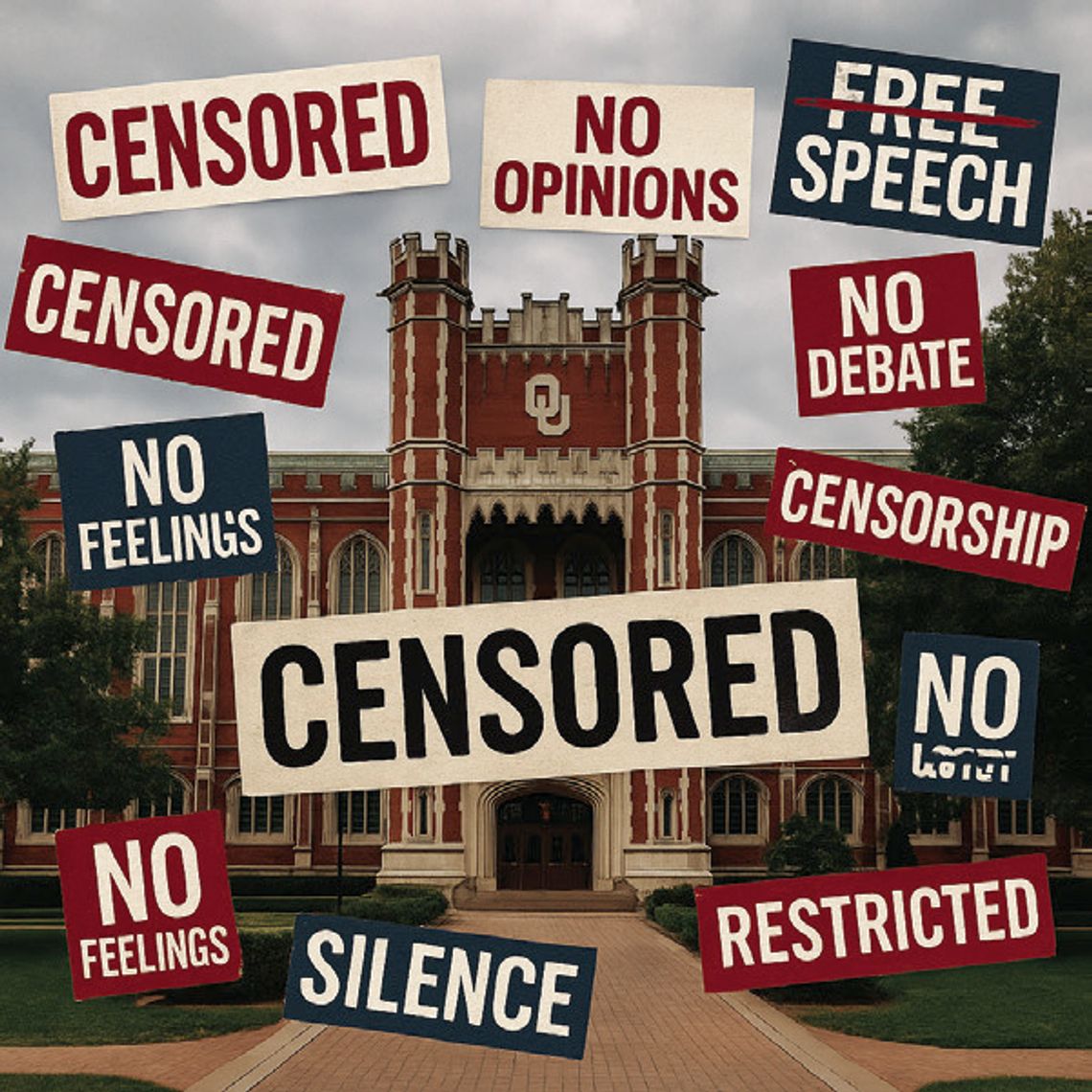
You’ve probably seen the headlines by now. A student at the University of Oklahoma turned in a short reaction paper for a psychology class, received a zero, and suddenly the entire country was arguing about free speech, religion, gender, and academic fairness. The names and political spin aren’t important here. What matters is the larger conversation this sparked — one that goes far beyond a single essay or a single classroom.
To understand why this blew up the way it did, we have to take a step back and acknowledge something most people forget: the way we talk about gender today is very new. For most of human history, “gender” wasn’t even a social identity. Before the mid-20th century, it was a grammatical term — words were masculine, feminine, or neutral. People weren’t.
It wasn’t until the 1960s that psychologists and sociologists began separating gender from biological sex. Concepts like gender identity, gender expression, and nonbinary categories have existed for only a few generations — younger than color television. That doesn’t delegitimize them, but it reminds us that people approach these discussions from dramatically different starting points. One group grew up understanding gender as fixed biology. Another grew up understanding gender as personal identity. Neither group thinks they’re being extreme; both believe they are standing on truth.
That context matters when controversies like this land in our state. And for Oklahomans, OU is more than just a university — it’s a point of pride. We celebrate its successes, brag about its achievements, and expect it to uphold the fairness and integrity that make it respected across the region. When something feels off, we pay attention not because we dislike OU, but because we care about it.
And caring means asking hard questions.
The first question is simple: What exactly was the assignment?
Was the student required to engage directly with an article?
Were they told to use peer-reviewed sources?
Were certain types of evidence — including religious texts — clearly excluded?
If the instructions required academic engagement and empirical reasoning, then a paper based purely on personal belief may not meet the criteria. In scientific disciplines, evidence has a specific meaning: data, studies, theory, research. A religious text can be personally authoritative, but it is not treated as scientific evidence. That’s not disrespect; it’s methodology.
But here’s where the clarity ends — and the controversy begins.
The teaching assistant who graded the paper stated that parts of it were “offensive.”
That is the piece we cannot ignore.
Because regardless of how strong or weak the paper was, and regardless of whether it met the assignment’s academic expectations, “this offends me” is not an academically valid reason to fail a student.
Offense is not a metric. Emotion is not a rubric. Personal reaction is not a standard.
Th e moment a grade becomes tied to the grader’s feelings — whether on the left, right, or anywhere in between — the evaluation stops measuring comprehension and starts measuring ideological alignment. And once that door opens, every student becomes vulnerable to the worldview of whoever is holding the red pen.
That doesn’t mean the student was automatically right. It doesn’t mean the paper was academically sound. It doesn’t mean religious belief substitutes for scientific reasoning. It simply means this: A university cannot punish a student based on subjective offense.
A university can critique writing, structure, logic, evidence, or engagement with the prompt.
A university cannot penalize someone simply because their viewpoint feels uncomfortable.
Both things can be true: (1) The student may not have met the assignment’s academic expectations.
(2) The grader was wrong to justify the score based on personal offense.
And these two truths point to the same solution: clearer expectations and objective standards.
Because universities are supposed to be places where ideas — even controversial ones — can be expressed, challenged, debated, and held to consistent academic criteria. If disagreement becomes grounds for punishment, if discomfort becomes the deciding factor in a grade, then higher education stops being an environment for learning and becomes a battleground for ideological compliance.
The question at the center of this controversy is not whether the student’s beliefs were correct. It’s not whether the grader’s identity influenced their reaction. And it’s not whether one side of the political aisle “won.”
The question is simple: Will our public universities grade students based on academic standards, or will personal offense decide who passes and who fails?
Because you cannot build higher education on emotion.
You cannot build it on fear of disagreement.
And you cannot build it on ideology — left, right, or anything in between.
You can only build it on standards everyone can see.